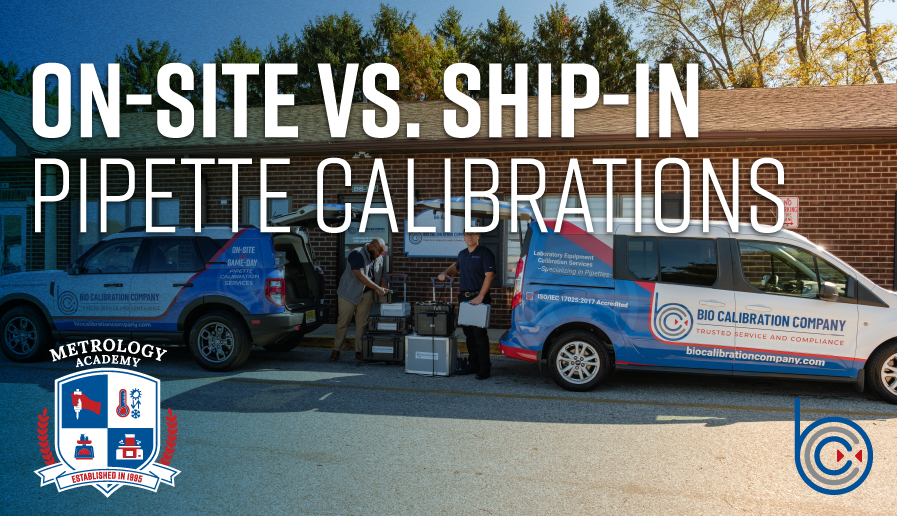
On-site vs. Off-site Calibration for the Pharmaceutical Industry



If you are an organization selecting a provider for pipette calibration services, you are probably wondering whether on-site or off-site pipette calibration is best for your organization. Just for clarification, on-site pipette calibration is when the calibration provider brings their equipment to your lab and calibrates your pipettes in your lab environment. Off-site pipette calibration, on the other hand, is when you send your pipettes to the calibration lab for calibration servicing. The good news is that both are viable options offered by Bio Calibration Company.
When calibrating pipettes, you want to ensure that your calibration results are reliable and have a low risk of leading to nonconformities. Let’s take a look at the risks and benefits of both onsite and offsite calibration services for pipettes.
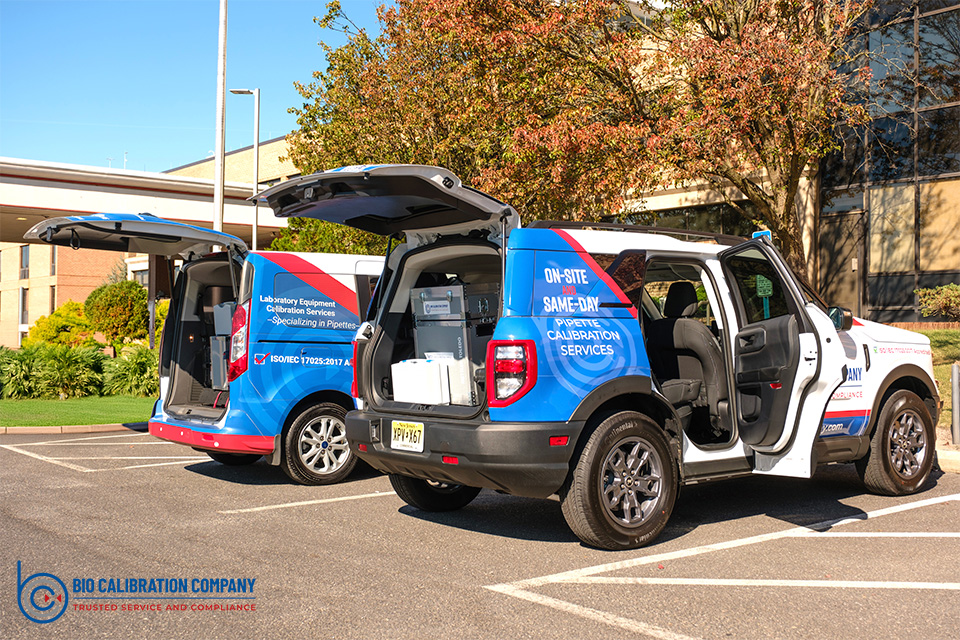
On-site Pipette Calibration Services
For on-site pipette calibrations, the immediate benefits are faster turnaround times and no need to ship your lab equipment to be calibrated. There are, however, potential risks including less environmental control during pipette calibration, possible damage to lab equipment standards during transit (reference equipment used for the pipette calibration), the pipette calibration company not properly accounting for the environmental conditions in your lab, and the lab calibration company not performing proper checks of reference equipment prior to using it onsite.
As expected, many of the risks associated with pipette calibration can be significantly reduced by selecting the right calibration provider. Choosing a provider accredited to ISO/IEC 17025:2017 is an important step, but selecting one that goes beyond the minimum requirements and follows robust procedures for on-site calibrations is equally valuable in ensuring the highest pipette calibration quality. Bio Calibration Company is an ISO/IEC 17025:2017 accredited laboratory that performs pipette calibrations in accordance with ISO 8655. In addition to maintaining accreditation, we have established procedures to ensure the reliable and safe transport of reference standards, including analytical balances. Upon arrival at the facility, our technicians perform lab equipment verification to confirm the validity and integrity of all measurement results.
Technicians also document the environmental conditions in the areas where pipettes are used and calibrated. These environmental data sets are incorporated into the z-factor calculation, which compensates for environmental variability when converting mass in grams to volume in microliters. Measurement accuracy is further supported by evaluating multiple relevant contributors to measurement uncertainty. These contributors are defined within the applicable ISO TR standards, enabling Bio Calibration Company to provide a sample-specific measurement uncertainty for each calibration.
Off-site Pipette Calibration
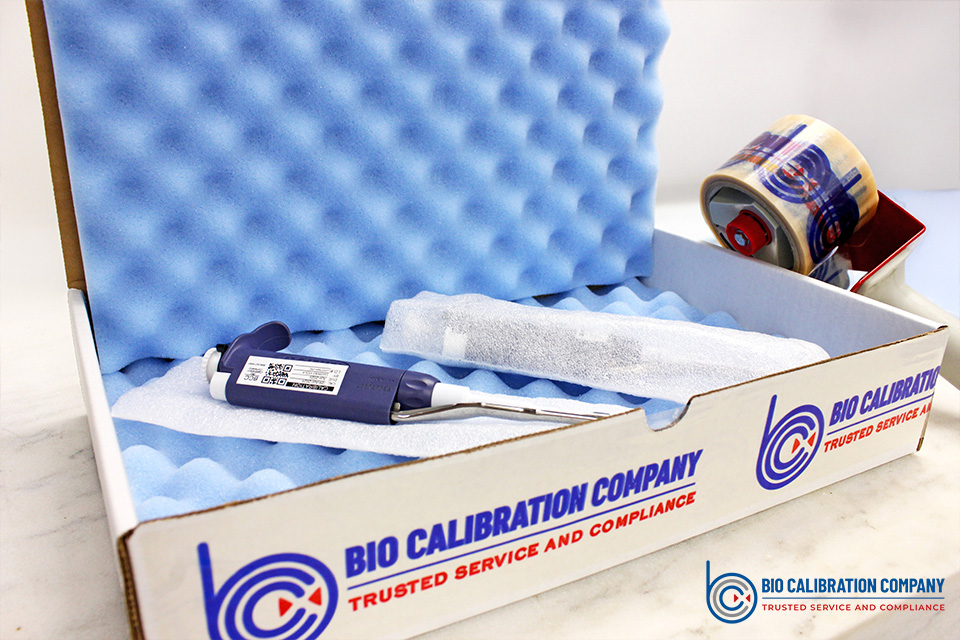
The other option is to ship your pipettes to the calibration provider for pipette calibration at their facility. This is a good option for organizations interested in greater environmental control and in having calibration results and uncertainties reported under the best possible conditions. There are two possible issues with this option. The first is that there is always a chance of shipping issues and not having your equipment under your control throughout the calibration service. The second issue is related to the benefit of using the ship-in method, the environment in which the pipettes are being calibrated. It can be a positive to have pipettes calibrated in a more controlled environment, but it could be a potential disadvantage in some cases. For instance, you might want to know how your pipettes and their uncertainties perform in your lab’s conditions rather than in another lab’s.
Should I choose on-site or off-site pipette calibrations?
There is no issue with sending pipettes out for calibration; it is a great option. However, having pipettes calibrated on-site can be advantageous because the turnaround time is quick, and it reduces the risk of transporting your equipment through a carrier. Just remember to choose a good lab to partner with that accounts for the environmental conditions, their standard transportation risks, and other factors that could have a negative impact on results. If you ask a lab how they reduce these risks, they should have good answers.
Conclusion:
Choosing between on-site and off-site pipette calibration isn’t about which option is “better” in general. It is about which option best manages risk for your lab. On-site pipette calibration offers a quick turnaround and keeps your pipettes under your control, but only works when the provider properly manages risks, including environmental conditions, reference equipment transport, and verification checks. Over our 30 years in business, we have found on-site pipette calibration to be an effective way to provide efficient pipette calibration services. Off-site pipette calibration provides tighter environmental control and strong uncertainty reporting but introduces shipping risk and may not reflect how pipettes perform in your lab environment. Off-site calibration is offered to customers as a value-added option for their calibration needs, which some prefer.
Both approaches are valid, both support compliance, and both can cause problems if done poorly. The deciding factor is the pipette calibration partner and how seriously they take the details that matter, such as environmental data, uncertainty calculations, reference standard integrity, and documented procedures.
Bio Calibration Company is built for both models. Our ISO/IEC 17025:2017 accreditation, full compliance with ISO 8655, including controlled transport and verification of reference standards, environmental monitoring during on-site work, and a state-of-the-art laboratory for off-site services ensures reliable results regardless of where pipette calibration occurs. Whether pipettes are calibrated in your lab or ours, the focus is the same: defensible data, reduced risk, and calibrations you can stand behind during audits.
Pick the pipette calibration method that fits your operation and partner with a lab that knows how to execute both correctly.
Get a Quote or Contact Us, Today!