Competence Requirements in ISO/IEC 17025:2017 Accredited Laboratories



Why Outsourcing Calibrations to an ISO/IEC 17025:2017 Accredited Lab is so Important
When outsourcing your equipment calibrations, it’s important to know the qualifications of the vendor you’re choosing to do the work. A great way to take a lot of the work out of vendor qualifications is to use ISO/IEC 17025:2017-accredited labs. This way, you will know they have a Quality Management system in place that goes through routine audits. One reassurance you can have from an accredited laboratory is that you know they have competent personnel calibrating your equipment. ISO 17025 auditors are checking that the lab has a good training and competence program.
How do I know if a Lab is Accredited?
What it means for a lab to have ISO/IEC 17025:2017 accreditation is that it has undergone a surveillance audit, demonstrating to an accreditation body that it meets the minimum requirements detailed in ISO/IEC 17025:2017. An accreditation company is a company qualified to determine whether labs meet the requirements of ISO/IEC 17025:2017. The accreditation company sends an auditor to the laboratory to perform a surveillance audit and award the lab accreditation status.
One way to tell if a laboratory is accredited is to check its calibration certificates. If its certificates have an accreditation logo, then it is issuing accredited calibrations. Here is an example of Bio Calibration Company’s ISO/IEC 17025:2017-accredited calibration certificates.
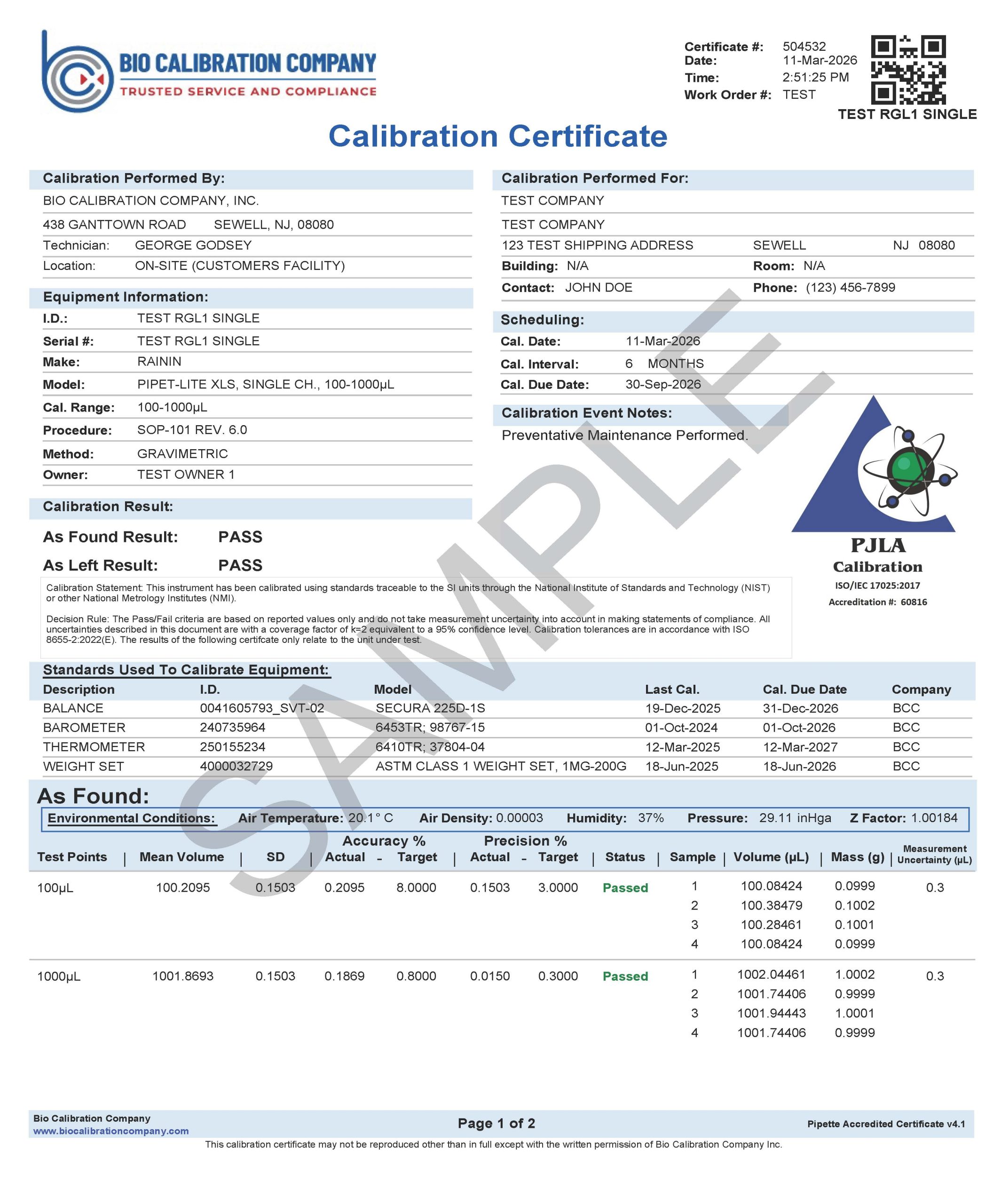
Another way to check whether a lab is accredited is to look on its website for a document called a scope of accreditation. An accreditation scope is a document that outlines the measurements and ranges for which a laboratory is accredited to perform. It’s a good idea to know what is on a laboratory’s scope of accreditation because they may be accredited for the calibration, but they may not be accredited for the range that you need.
You can view Bio Calibration Company’s Scope of Accreditation here for a full breakdown of our accredited ranges and capabilities: https://biocalibrationcompany.com/compliance/quality-systems-and-compliance
Accredited Laboratories must have Competence Requirements for their Calibration Technicians
There are many times when purchasing calibration services for your company, you may wonder whether the company you hired has competent employees for the calibrations you are requesting. The reason outsourcing to an ISO/IEC 17025:2017-accredited lab is so important is that such labs are required to meet the quality and technical requirements of ISO/IEC 17025:2017. This includes the requirement to have a program for their personnel to demonstrate competence and authorization to perform procedures and calibration methods.
An accredited lab is required to ensure its personnel have the competence to perform all activities and to evaluate the significance of deviations that may occur during laboratory activities. When accredited labs are audited by their assessors, they are asked to provide evidence of their employees’ competency.
Accredited Labs are Required to Demonstrate the Competence of their Laboratory Personnel
All accredited laboratories must have a training program and a policy for determining the competence of their calibration technicians. This means the company must have a policy that defines how they determine competency. An example of how many accredited labs accomplish this is through their training program. When a calibration technician starts with the company, they won’t be allowed to perform calibrations until they complete the required calibration training. Often, labs have a trainer who needs to sign off on a new lab technician’s competence. So they have to demonstrate competence through on-the-job training.
Another thing common amongst accredited calibration lab training programs is that they have a policy for authorizations in addition to competence. Customers are further protected against potential mistakes because lab personnel must be authorized to issue calibration certificates to customers. In addition to training on the calibration method, they must be authorized to issue those certifications to customers. This is done to ensure a minimum competence and experience standard for issuing calibration certificates to customers.
Conclusion
Outsourcing calibration work is a decision that affects measurement quality, audit defensibility, and ultimately the products or services your organization delivers. Choosing an ISO/IEC 17025:2017 accredited laboratory removes a substantial portion of the vendor qualification burden, as the accreditation itself confirms that the lab operates under a quality management system, undergoes regular third-party audits, and meets the technical and personnel requirements defined in the standard. Verifying accreditation status is straightforward. Check the calibration certificate for an accreditation logo, and review the laboratory’s scope of accreditation to confirm that the specific measurement and range you need fall within the accredited capabilities.
Personnel competence deserves particular attention when selecting a calibration provider. Accredited laboratories must demonstrate that their technicians have completed defined training, met documented competence criteria, and received authorization to perform the specific calibration methods assigned to them. They must also show that authorized personnel issue the calibration certificates that customers rely on. These requirements give purchasers a level of assurance that is difficult to replicate through internal vendor audits alone.
When evaluating calibration vendors, treat accreditation as a baseline rather than a marketing detail. Confirm the scope, review a sample certificate, and verify that the laboratory can support the measurements your processes depend on. If you are weighing calibration vendors or working through the qualification process for an accredited provider, Precision ISO can help you evaluate scopes, certificates, and competence evidence so that your outsourcing decisions hold up under both internal review and external audit.