Why Automated Liquid Handling Systems Are Replacing Manual Pipetting



For years, the standard picture of a laboratory pipetting station was a technician holding a handheld pipette, drawing up sample after sample by hand. That picture is changing. More labs are moving toward automated liquid handling systems to take over the repetitive pipetting work that used to be done by hand. These systems, also known as liquid-handling robots or automated pipetting systems, dispense liquids into microplates and tubes with minimal human intervention. The shift is happening across pharmaceutical companies, biotechnology firms, clinical diagnostic labs, and academic research centers. The reasons behind this move are straightforward. Labs are processing more samples than ever, the volumes they work with are getting smaller, and the pressure to produce accurate and repeatable results has never been higher. This article examines why labs are using these systems, what sets them apart from handheld pipettes, why they still require calibration and maintenance, and how Bio Calibration Company supports labs that run them.
The main driver behind automated liquid handling is throughput. A technician working by hand can only pipette so many samples in a day before fatigue sets in, and errors start to creep in. An automated system runs the same protocol hundreds of times without tiring and without the variation that comes from a human hand. This matters most in high-throughput screening, next-generation sequencing, PCR setup, and ELISA work, where a single run may entail thousands of individual dispenses. The market reflects this demand. Industry analysts value the global automated liquid handling market at roughly 3.5 billion dollars and project it to grow to more than 6 billion dollars by 2035. Adoption of these systems in United States clinical laboratories has been growing at about 12 percent per year.
Accuracy and reproducibility are the second most common reasons labs make the change. Manual pipetting introduces variation between technicians, between shifts, and even between the first and last sample of a long run. Automated systems remove much of that variation by executing the same motion every time. This is exactly the kind of reproducibility that regulated environments demand. Labs operating under FDA and ISO requirements need to demonstrate that their results are consistent and that their data hold up under audit. Automation helps them meet that bar by reducing human error and producing a cleaner record of what happened during each run.
Cost and volume also push labs toward automation. As assays shrink to conserve expensive reagents, the volumes being dispensed drop into the microliter and even nanoliter range. Dispensing those volumes accurately by hand is difficult and inconsistent. Automated systems handle small volumes far more reliably, and by miniaturizing assays, labs can significantly reduce reagent costs. When you combine higher throughput, better accuracy, and lower reagent use, the case for automation becomes clear.
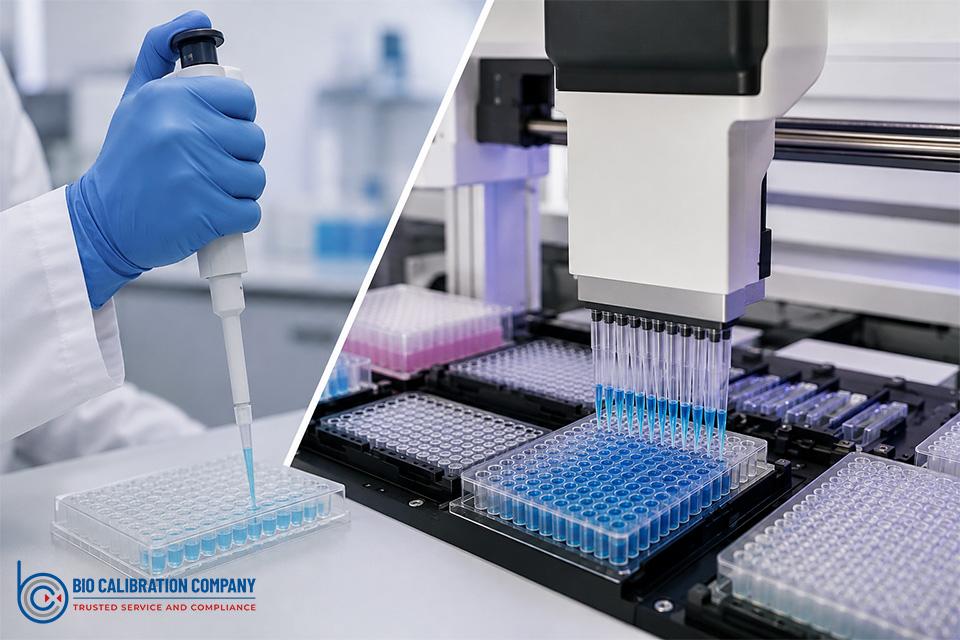
An automated liquid-handling system is not merely a motorized pipette. It is a platform that combines dispensing heads, a movable deck, disposable or fixed tips, and software that controls the entire process. Many systems carry multiple channels, allowing them to fill an entire 96- or 384-well plate in a single pass. The most common dispensing technologies are air displacement and positive displacement, though acoustic systems that move liquid without any physical contact are gaining ground for the smallest volumes. Disposable tips dominate the market because they reduce the risk of carryover contamination between samples.
The difference in scale changes how a lab thinks about verification. A handheld pipette has one channel and one volume setting to check at a time. An automated system may have dozens of channels, each of which needs to deliver the correct volume, and it runs protocols that a technician never touches once the run begins. This is a strength because it removes human variation, but it also means that when something drifts out of specification, it can affect a large batch of results before anyone notices. A single channel dispensing slightly low across a full plate produces an error that repeats across every sample on that plate.
There is also a standards difference that many labs overlook. Handheld and semi-automated pipettes are calibrated to ISO 8655, the long-standing standard for piston-operated volumetric apparatus. Automated liquid handling systems fall under a separate, newer standard, ISO 23783, published in 2022 and replacing the earlier international workshop agreement, IWA 15. ISO 23783 specifies measurement procedures, performance determination, and reporting requirements for automated equipment. Labs that assume their automated platform is covered by the same standard as their handheld pipettes are working from the wrong document.
A common misconception is that automation removes the need for calibration. The opposite is true. Because an automated system runs unattended and dispenses the same amount across large batches, a small error has a much larger impact than it would on a handheld pipette. If one channel drifts and no one is checking, every plate that channel touches carries the same error forward. For this reason, automated systems need a defined calibration and maintenance plan, not an occasional spot check.
Calibration under ISO 23783 verifies that each channel dispenses its target volume within specification across the range the lab uses. This is the evidence a lab needs to prove that its results are traceable and that its instrument is fit for purpose. Regulated labs face real consequences when this evidence is missing. A gap in calibration records is one of the most common findings in a pharmaceutical audit. When an instrument runs without documented qualification, the data it produces during that gap can be called into question, and in serious cases, that means quarantined product, regulatory findings, and costly investigation. In a pharmaceutical production setting, downtime and failed batches carry a price measured in the millions.
Maintenance is the other half of the plan. These systems have moving parts, seals, tips, and dispensing mechanisms that wear over time. Preventive maintenance, including cleaning, inspection, seal replacement, and mechanical checks, keeps the system dispensing accurately and prevents failures that stop a run in the middle of a batch. A good maintenance program schedules this work during planned windows rather than reacting after a breakdown. Pairing preventive maintenance with a documented calibration schedule keeps the instrument equally accurate and audit-ready, and protects the lab from the surprise of an out-of-specification result traced to a worn part.
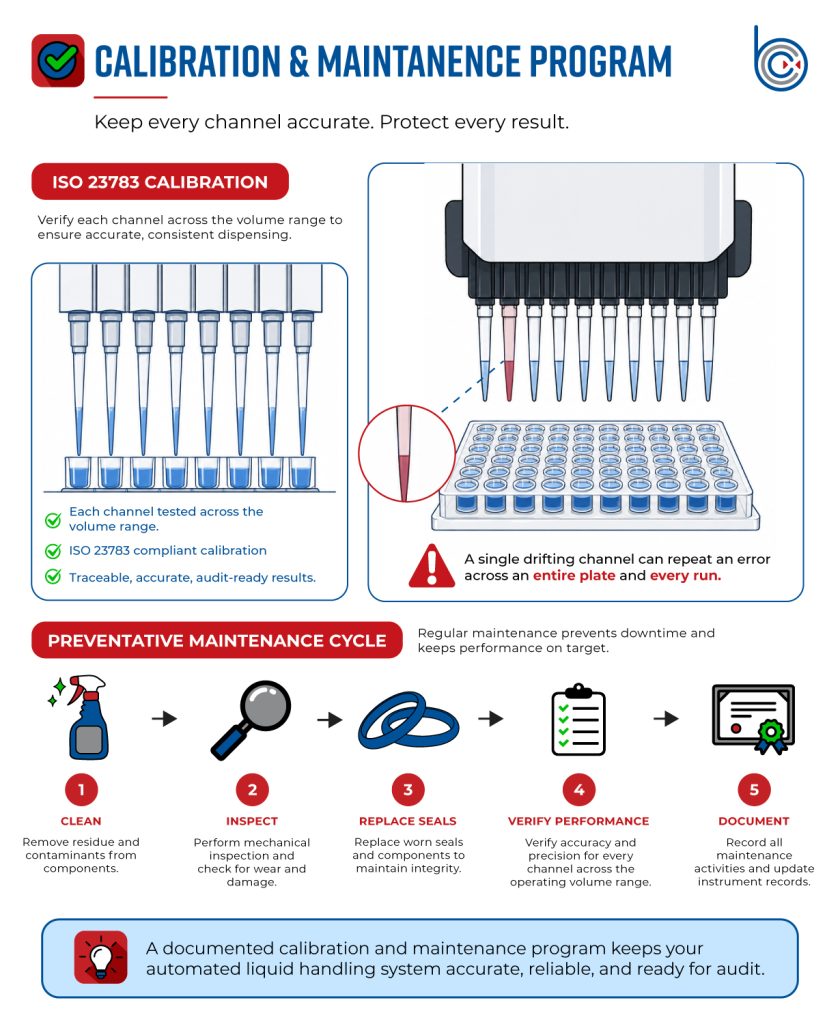
Bio Calibration Company works with labs that run both handheld pipettes and automated liquid-handling systems, so a lab does not have to manage two separate providers for its liquid-handling equipment. For automated equipment, calibration work follows ISO 23783, the standard for these platforms, and is performed under an ISO/IEC 17025:2017-accredited framework, ensuring results are traceable and defensible in an audit. Each channel is verified across the volume range the lab actually uses, and the calibration is documented in a report that a lab can hand directly to an auditor.
Beyond calibration, Bio Calibration Company helps labs build calibration and maintenance plans that keep these systems compliant over time. This includes setting appropriate calibration intervals, scheduling preventive maintenance during planned windows, and tracking certificates so that no instrument runs past its due date. For a lab under FDA or ISO requirements, this kind of structured program is the difference between a routine inspection and a scramble to explain a documentation gap. The goal is simple. Keep the instrument accurate, keep the records complete, and keep the lab set for whatever an auditor asks to see.
Automated liquid handling is no longer a niche technology reserved for the largest facilities. It is becoming standard equipment across the industry as labs push for more throughput, tighter accuracy, and smaller volumes. But the move to automation does not remove the requirement of careful metrology. It raises the stakes, because these systems run large batches without a human watching every dispense. A lab that invests in an automated system should invest just as deliberately in the calibration and maintenance plan that keeps it trustworthy. Bio Calibration Company is ready to help labs put that plan in place and keep their liquid handling equipment, manual or automated, delivering results they can stand behind.