The calibration industry is like every other industry: it will leverage technology that makes tasks more efficient. Artificial Intelligence is an emerging technology that can’t be ignored. Every industry that touches data, documentation, and repetitive review work is finding places for AI to fit, and calibration is no exception. Labs handle a high volume of certificates, work orders, measurement data, and customer requests, and much of that work follows patterns that a well-built tool can learn. That is exactly the kind of environment where AI starts to earn its place. The calibration industry can leverage AI in many ways to make its processes more efficient. There are also a couple of things to watch out for, and we will cover those as well. This article walks through where AI stands from a regulatory standpoint, the specific tasks calibration companies will hand to AI, and the questions you should ask your provider before AI touches anything tied to your results.
AI in Calibration and Why It’s Not Going Away
From a regulatory standpoint, AI has not yet worked its way into ISO standards. ISO/IEC 17025:2017 and ISO 9001 don’t include clauses covering AI regulations, but they eventually will. It’s just a matter of time. Standards bodies tend to move more slowly than technology, so there is a gap right now between what labs can do with AI and what the standards specifically address. That gap does not make AI any less relevant. AI still earns attention because it reduces costs and improves efficiency in ways service providers cannot ignore. A lab that uses these tools well can turn work around faster, spend less staff time on repetitive review, and pass some of that savings on to the customer. Labs that figure this out early will have an advantage, which is why the technology isn’t going away.
Ways That Calibration Companies Will Use AI
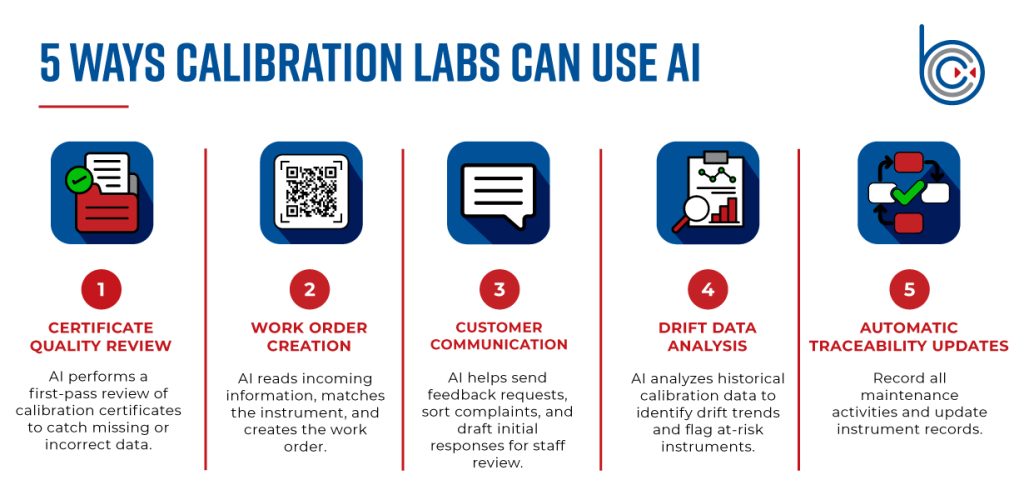
Here are a few examples of what AI may be automating for labs in the near future, if not already.
- Calibration certificate quality check or review. Every certificate a lab issues gets reviewed before it goes out the door. A reviewer checks that the data is complete, the units are correct, the dates line up, and nothing is missing. AI can perform this first-pass review in seconds, flagging certificates with missing fields, transposed numbers, or values outside expected ranges. This doesn’t replace the reviewer, but it catches obvious errors before a human ever looks, speeding up the process and reducing the chance a mistake slips through.
- Incoming work labeling and work order creation. When equipment arrives at a lab, someone has to identify it, log it, and create a work order with the right instructions. AI can read the incoming information, match the instrument to the correct calibration procedure, and automatically generate the work order. This reduces manual data entry at the receiving end and cuts errors from typing the same information by hand repeatedly.
- Customer communications such as complaints and feedback. Labs often struggle to keep up with proactive customer communication because it takes staff time. AI can automate parts of this, such as sending feedback requests after a job is complete, sorting incoming complaints by type, and drafting initial responses for a staff member to review. The result is that customers could actually get more communication from labs, not less, because the lab has a more automated way of asking for feedback and handling routine messages.
- Analyzing drift data or multiple calibration certificates. Looking at how an instrument drifts over time, or comparing results across many certificates, is the kind of analysis that takes a person a long time to do by hand. AI can review a history of certificates for a single instrument, identify drift trends, and flag equipment that is heading toward an out-of-tolerance condition. This lets a lab spot problems early and gives customers better information about how their equipment performs across cycles.
- Updating traceability information automatically when standards are calibrated. When a lab recalibrates its reference standards, that new traceability information has to flow into every certificate that relies on those standards. AI can handle this update automatically, pulling the new calibration data and applying it wherever it belongs. This keeps traceability records current without someone manually updating each linked record, making it faster and less error-prone.
Questions to Ask Your Calibration Provider
These all could be positive things. However, since this is new technology, it is a very good idea to ask your calibration providers these important questions.
- Are you using AI for anything that will affect my measurement results? This is the first thing to establish. There is a real difference between AI that handles back-office tasks and AI that touches the measurement data or the decisions made about it. You have a right to know which one your provider is doing.
- If so, can you provide validation documents for the tools you are using? Any tool that affects results needs validation, just like any other method or software a lab uses. Ask to see it. A provider that cannot produce it is using a tool they have not properly verified.
- Can you put a disclaimer on my reports if they are only quality checked by AI without a human in the loop? If an automated tool reviewed a certificate and no person verified it, you should know that. Ask your provider to disclose this on the report so you can decide whether that level of review meets your requirements.
- Is AI logic being applied to statements of conformity? A statement of conformity is the lab’s decision about whether your equipment passed or failed. Applying AI to that decision carries more weight than a first-pass data check. Find out whether AI drives these pass or fail decisions and how the lab manages the risk that comes with it.
Conclusion
AI is going to become a normal part of how calibration labs operate, and used carefully, it will make their work faster and more consistent. The key is knowing where your provider applies it and making sure the tools that touch your results are validated and disclosed. Ask the questions above, get clear answers, and you can take advantage of the efficiency AI offers without giving up the confidence you need in your calibration results.