Gravimetric vs. Photometric Pipette Calibrations



In the pharmaceutical industry, pipette calibration is very important. Pipettes deliver the precise volumes that drug formulation, quality control testing, and research depend on. When a pipette drifts out of tolerance, it dispenses the wrong volume, and that error carries forward into every result that relies on it. In a regulated environment, this creates real problems. Inaccurate volumes compromise assay results, put batch quality at risk, and can lead to failed audits or regulatory findings. Calibrated pipettes protect data integrity, support compliance with FDA and ISO requirements, and give scientists confidence that their results reflect reality and not instrument error. As you can see, pharmaceutical companies need to choose the right calibration provider for their pipettes. This article explains two commonly used methods for calibrating pipettes and the benefits and drawbacks of each.
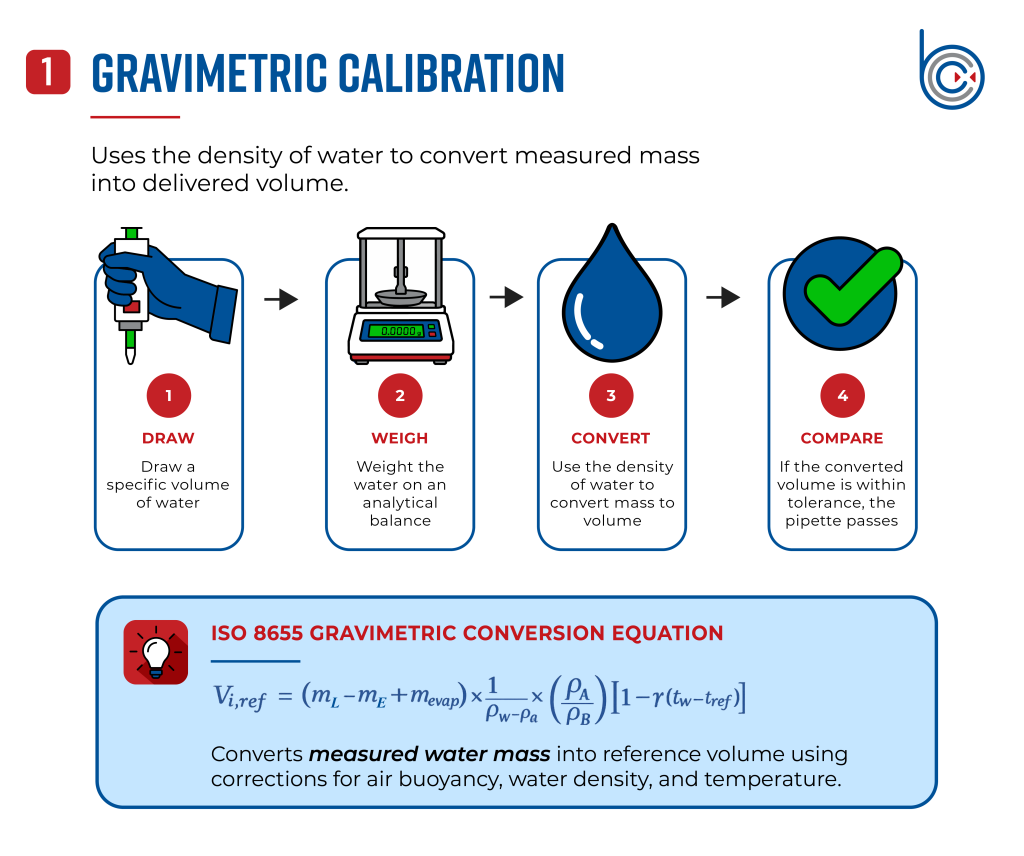
The first method we will discuss is the gravimetric method for pipette calibration. This method actually uses a mass measurement and converts it to a volume using the density of water. That may be confusing, but let’s dive into that. The primary method calls for an analytical balance (to take a weight measurement), Deionized Water (DI water), and the pipette to be calibrated (DUT or device under test).
The idea behind this calibration is to use the pipettes to draw up a specific volume of water and then verify that volume by weight. So, the calibration technician will weigh the water drawn up in the pipette on the analytical balance, then use the density of water to convert the mass to a volume. If the pipette’s liquid amount weighs to the expected converted volume, the pipette will be considered in tolerance.
Something to note for readers who are interested in how gravimetric methods work in more detail. There is an ISO method that details how to perform this calibration. Bio Calibration Company offers a pipette calibration service that uses the ISO 8655 method. I’m drawing attention to the fact that the conversion from mass to volume isn’t done by simply applying the density of water. The real conversion happens with this equation below. The equation uses the density of water, the air density in the lab, the thermal expansion of water, the temperature of the water, and the mass of the liquid to calculate a volume. Many of the variables in this equation are equations in themselves. For example, air density (Pa) is an equation itself, not just a static variable.
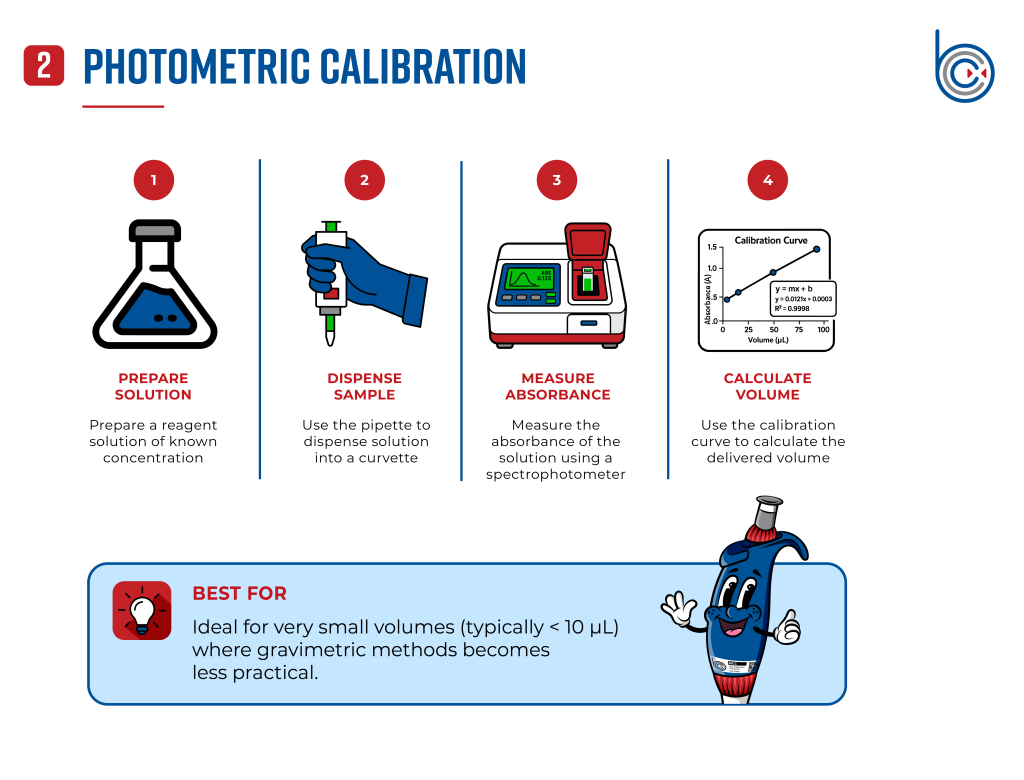
The second method we will discuss is pipette calibration using the photometric technique. This method uses an indirect measurement by measuring the absorbance value of reagent solutions at known wavelengths. A technician using this method will first prepare a known volume of diluent. Then they will pipette the reagent solution into the diluent. After this, they will measure the absorbance of that solution at the wavelength at which the reagent absorbs. The volume dispensed by the pipette is verified by comparing it to a calibration curve. A calibration curve is created by using a calibrated pipette with low, medium, and high volume settings to pipette the reagent into known diluent solutions. The technicians then take the absorbance value at each of these calibrated volumes and create a calibration curve. The calibration curve will create a linear equation (y = mx + b) that can be used to calculate the volumes of uncalibrated pipettes.
Photometric calibration works by measuring an optical signal and correlating it with volume based on the concentration of reagent in the wells of a microplate. Two companies stand out as competitors in this space: Artel and Automation Trainer. Artel’s systems, the PCS and MVS, use proprietary dye-based reagents and a dual-dye ratiometric photometry approach. The reagent kits contain standardized colored solutions that are measured at two wavelengths, and the ratio of the absorbance signals is used to calculate the dispensed volume. Automation Trainer’s GLH QC Kit takes a different path, using a single-dye absorbance method rather than Artel’s dual-dye ratiometric technology. The GLH system uses QC reagents that a technician dispenses into reference and test plates, then measures them with either the GLH reader or a compatible plate reader.
Below is an image to help conceptualize photometric calibration.
Both methods are sound for calibrating pipettes. There are better times to use one or the other, and each method has pros and cons. The gravimetric calibration method is great for simple, direct, traceable calibration. This is the case because you are comparing the volume of the liquid directly with a weight measurement (using a calibrated scale), so there is direct traceability. Gravimetric calibration measures a physical mass, which makes it the reference or traceable method in most labs. The weigh, print, and tare method follows a direct line of metrological traceability. The issue with gravimetric calibrations is that they are very labor-intensive, and the method limits you to handheld instruments with a limited number of channels.
On the other hand, photometric calibration is also a reliable method for calibrating pipettes. This method is very good for calibrating small-volume pipettes (like 10 uL or less). This is true because, when performing small-volume pipetting with an analytical balance, the balance you purchase must be very sensitive and capable of measuring extremely small masses. So, those balances are going to be very expensive. With the photometric method, you can calculate smaller volumes using the calibration curve as shown above. So, it’s a really good choice for small volumes, reaching down to 1 nL. Photometric also shines for high-throughput and automated liquid handlers. Multiple channels can load a plate with multiple repetitions, filling up the entire plate and running it once.
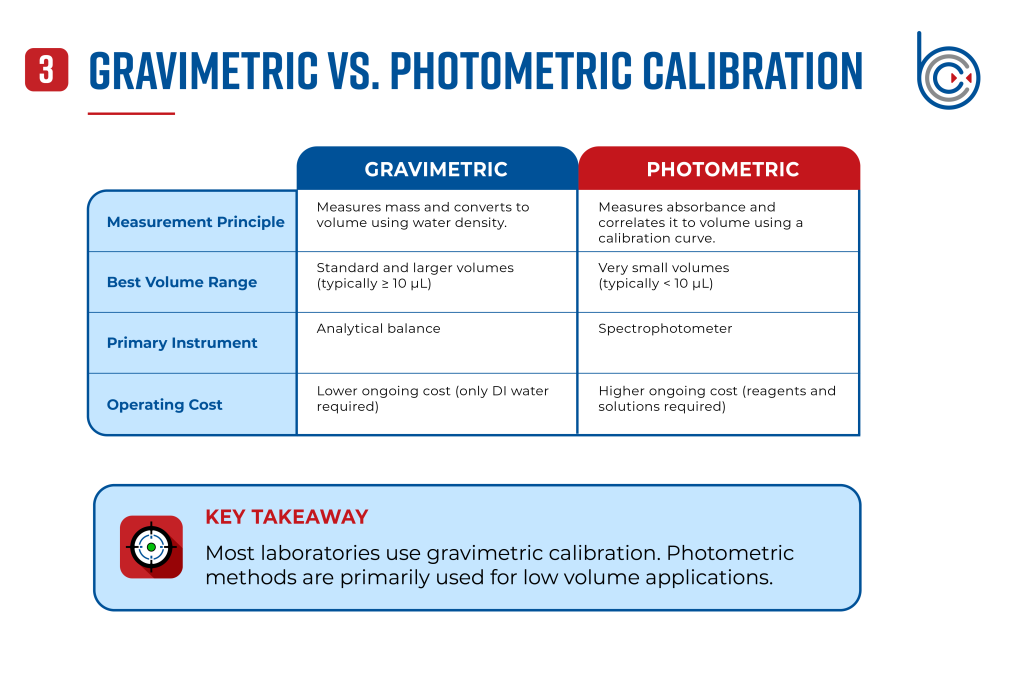
The two methods also differ in terms of cost. With gravimetric, once you buy the balance, you can measure almost infinite amounts because you are only measuring DI water. The photometric method requires you to keep buying the solutions and reagents that you measure, which adds ongoing cost. The table below compares the two methods across the factors that matter most.
Both gravimetric and photometric calibration are valid, defensible methods for verifying pipette performance. The right choice comes down to the instruments you run and the volumes you work with. Gravimetric calibration remains the tried-and-true reference method, offering a direct line of metrological traceability that works well for handheld single- and multi-channel pipettes. Its main drawbacks are the labor required and the expensive balances needed to reach very small volumes. Photometric calibration answers both of those limitations. It handles low volumes down to 1 nL and supports high-throughput work, where 96- and 384-channel instruments and automated liquid handlers can fill and read an entire plate in a single run. Its ongoing reagent cost is the trade-off for that speed and range.
For a pharmaceutical lab, the decision does not have to be one method or the other. Gravimetric serves handheld single- and multi-channel pipettes, while photometric serves 96- and 384-channel high-throughput instruments and automated liquid handlers. Bio Calibration Company uses both methods to provide greater capabilities across all types of liquid handling, ensuring your instruments are matched to the method that best suits them. When you select a calibration provider, look for one that understands both techniques and can apply the right one to each instrument in your lab. That is how you protect your data, your compliance standing, and the accuracy on which your work depends.