


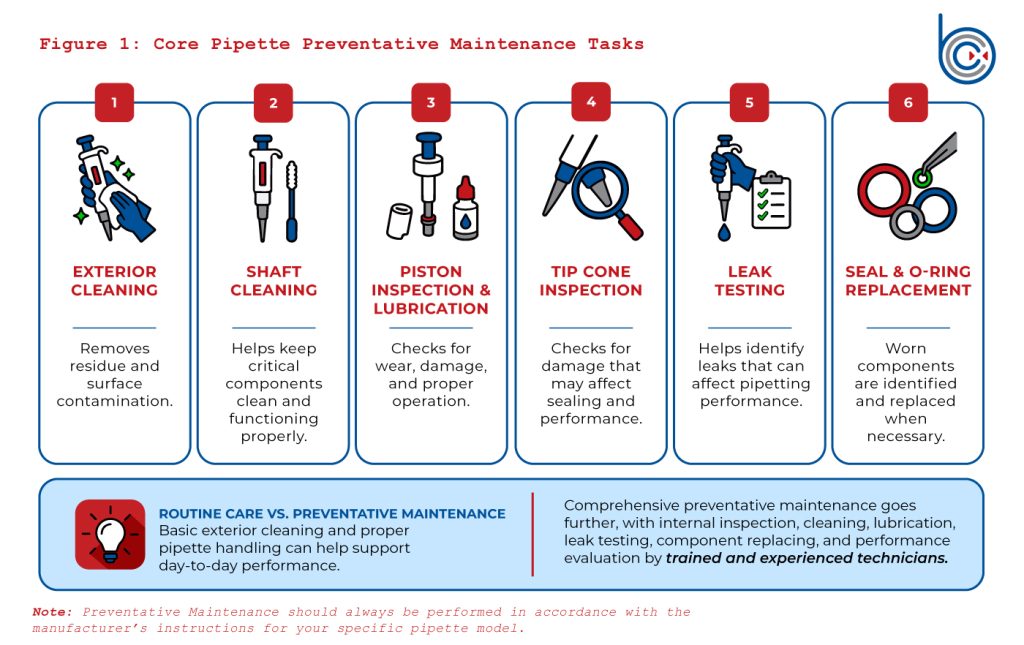
Pipettes are among the most used instruments in a laboratory and, at the same time, some of the easiest to overlook. A pipette that appears in good condition externally may still go out of tolerance due to a worn seal, a corroded piston, or dirt in the shaft. That is why preventive maintenance is important. It ensures the pipette remains mechanically sound so it can dispense accurately between calibrations. Such maintenance can include cleaning, inspection, lubrication, replacing the seal and O-ring, checking the tip cone, and carrying out a leak test. If a laboratory carries out these tasks regularly, the instrument will be in better condition, and the lab will detect minor problems before they result in failed calibrations or, in the worst case, questionable data.
Before proceeding further, it helps to distinguish between two ideas that people tend to confuse. Calibration and preventive maintenance are not identical, and one does not replace the other. Calibration involves measuring how a pipette performs against a known standard and deciding whether it dispenses within the specified tolerance. It addresses one question: is the pipette accurate at this moment? Preventive maintenance consists of the ongoing care taken to keep the instrument in the condition required to remain accurate over time. It addresses a different question: will the pipette continue to perform between calibrations? Calibration tells you the instrument’s position on a particular day; preventive maintenance ensures it stays there.
This white paper explains what preventive maintenance for pipettes involves, how often a lab should perform it, and how a consistent program improves performance while lowering the risk of a bad result. It also addresses a question that comes up often. If a provider performs maintenance during calibration, is that enough? The short answer is that combining the two is a strong start, but it doesn’t cover everything a lab should do between cycles. The sections that follow walk through each of these points and show how a structured preventive maintenance program protects both the instrument and the data it produces.
Preventive maintenance for pipettes is scheduled care that keeps the instrument mechanically healthy, so it maintains accuracy between calibrations. A pipette is a mechanical device with moving parts, and those parts wear. Sealing components degrade from normal use. Residual moisture from aspirating multiple replicates can compromise the seal, and accidental aspiration of a liquid can corrode the piston over time. Dirt accumulates inside the shaft. Each of these problems chips away at accuracy and shortens the instrument’s usable life. Preventive maintenance addresses them before they cause a failure.
A preventive maintenance visit typically includes a set of routine tasks. The technician inspects the pipette for visible wear and damage, cleans the barrel and shaft, checks and lubricates the piston, and inspects the tip cone for damage that would affect the seal with the tip. The technician also performs a leak test to confirm the pipette holds a vacuum and replaces worn seals and O-rings. These tasks keep a pipette dispensing the way it should, and many of them are the same tasks that quietly go undone when a lab treats calibration as the only service its pipettes need.
What a Lab Can Handle In-House and What Is Better Outsourced
Some maintenance a lab can reasonably handle on its own. Daily and weekly care such as wiping down the exterior, checking for obvious damage, and running a simple leak check are well within reach of a trained user, and doing them consistently prevents a lot of avoidable drift. These small habits are worth building into the lab’s routine because they cost almost nothing and they catch problems early.
Deeper maintenance is a different matter. Replacing seals and O-rings, servicing pistons, and correcting the issues found during a leak test often require manufacturer-specific parts, the right tools, and the experience to reassemble the pipette without introducing a new problem. Sourcing the correct parts for the many brands and models a lab may own is a challenge on its own, and an improper repair can leave a pipette in worse shape than before. This is where outsourcing to a dedicated provider makes sense. A provider that stocks the parts, knows the models, and documents every action gives the lab a clean maintenance record and a properly serviced instrument, without the lab having to build that capability internally.
No single maintenance interval fits every pipette, because not every pipette carries the same importance or risk. A useful way to plan is to sort pipettes by criticality. A critical pipette is one that is used heavily, used for high-value or regulated work, or tied to a result where an error would carry serious consequences. A low-criticality pipette is one that is used occasionally, handles less sensitive work, or would cause little harm if it drifted slightly between calibrations. Sorting instruments this way lets a lab put its attention where the risk actually is, rather than treating every pipette the same.
Once a lab has sorted its pipettes, it can build a maintenance plan for each category. For critical pipettes, the plan should be aggressive. These instruments require frequent preventive maintenance, frequent user-level checks such as leak tests, and a tighter calibration interval because the cost of failure is high and the instrument sees heavy use. Building scheduled maintenance around these pipettes keeps them in top condition and reduces the chance that a heavily used instrument drifts unnoticed. The heavier the use and the higher the risk, the more often the pipette should be inspected and serviced.
For low-criticality pipettes, the plan can be lighter without being careless. These instruments still need preventive maintenance and calibration, but the intervals can be longer because the use is lighter and the consequences of a small error are smaller. A practical approach is to set a baseline maintenance schedule for this group, monitor calibration results over time, and adjust the interval if the data shows the pipettes maintaining accuracy or beginning to drift. The goal is the same for both categories. Match the frequency of maintenance to use and risk, so no instrument is over-serviced without reason, and none is neglected until it fails.
A pipette that receives regular preventive maintenance simply performs better throughout its life. When seals stay fresh, pistons stay clean, and leaks are caught early, the pipette holds its accuracy and precision far longer than one that only sees a technician at calibration time. This consistency is the whole point. A lab depends on its pipettes to deliver the same volume today as they did last month, and preventive maintenance makes that dependability real. It preserves the mechanical condition the instrument needs to keep meeting its specification.
Regular maintenance also protects the instrument itself. Replacing a worn seal before it fails prevents the moisture intrusion and piston corrosion that would otherwise force an expensive repair or an early replacement. Cleaning the shaft before dirt builds up avoids the wear that shortens a pipette’s usable life. In practical terms, a lab that maintains its pipettes spends less on emergency repairs, replaces instruments less often, and keeps its equipment performing at a higher level for longer. Maintenance is not an expense that competes with the lab’s budget. It is what protects the investment the lab has already made in its instruments.
The risk side of the equation is just as important. Every calibration that comes back out of tolerance raises a question about the work done since the last good calibration. When a pipette fails, the lab must consider whether the results it produced in the meantime are still trustworthy, and in a regulated setting that question can lead to an investigation. Regular preventive maintenance lowers the chance of that failure and, just as importantly, puts more sets of eyes on the instrument between calibrations. A pipette on a maintenance program is inspected, tested, and serviced on a schedule rather than sitting untouched until its next calibration. That added attention means problems surface earlier, when they are cheap to fix, instead of surfacing as a failed calibration and a batch of data in doubt.
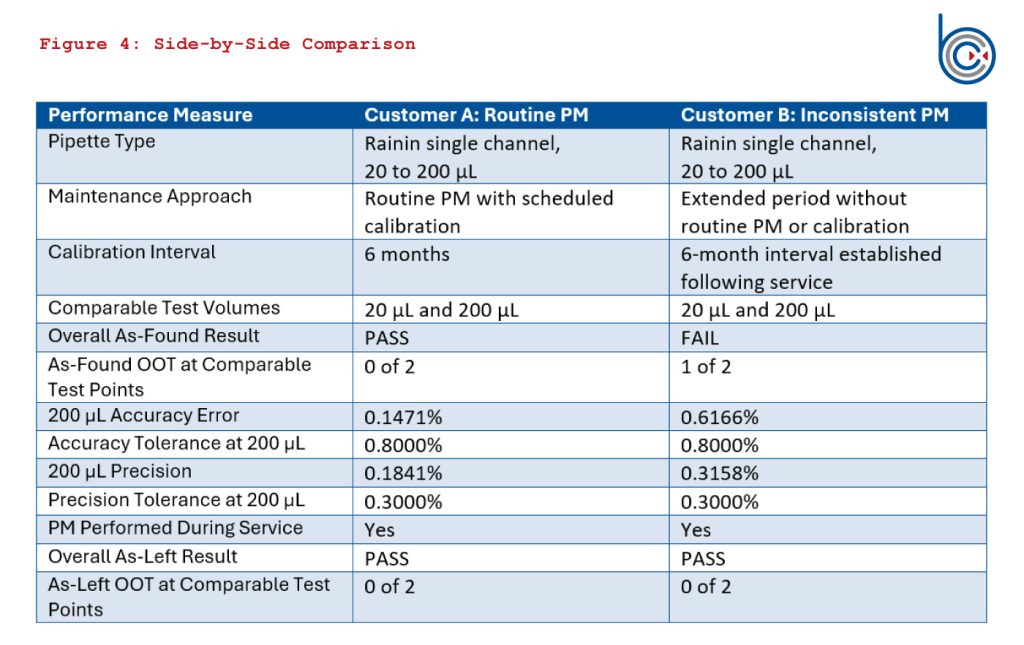
The difference between routine preventive maintenance and inconsistent maintenance can be seen in the condition of pipettes when they arrive for calibration. Bio Calibration Company compared service results from two customers with different maintenance histories. Both instruments were Rainin single channel pipettes with a 20 to 200 µL range. For a direct comparison, the results below focus on the two test volumes common to both service records, 20 µL and 200 µL.
Customer A: Routine Preventive Maintenance
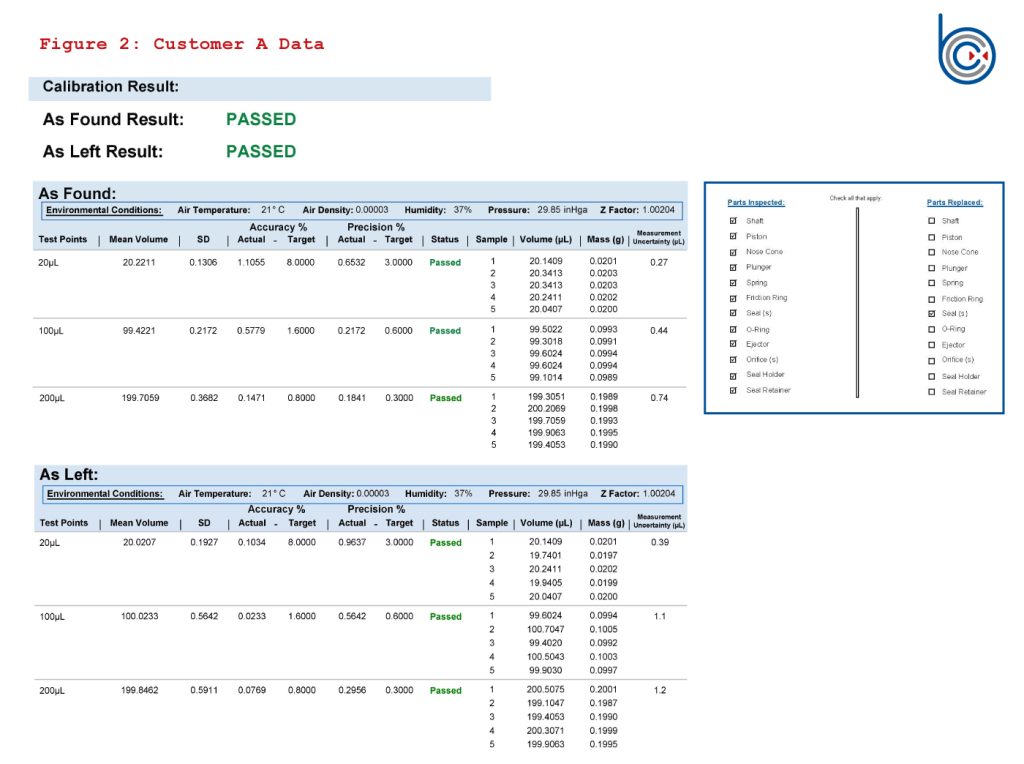
Customer A follows a consistent calibration and preventive maintenance program. The pipette is maintained as part of a six-month calibration cycle and arrived for its scheduled service performing within specification.
During As-Found testing, the pipette passed at both comparable test volumes, 20 µL and 200 µL. At the maximum 200 µL test point, accuracy error measured 0.1471% against an allowable tolerance of 0.8000%. Precision measured 0.1841%, also within the allowable tolerance of 0.3000%.
Preventive maintenance was performed as part of the scheduled service, and the pipette maintained an overall passing As-Left result.
Customer B: Inconsistent Preventive Maintenance
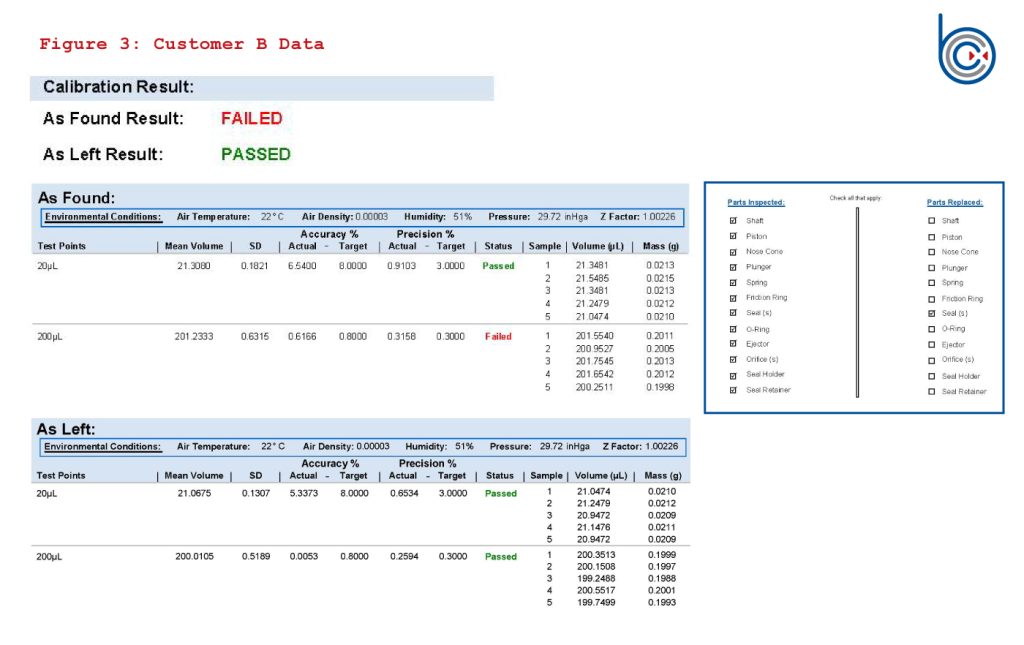
Customer B came to Bio Calibration Company after an extended period without routine calibration or preventive maintenance. Unlike Customer A, the pipette arrived for service with an out of tolerance condition.
The pipette passed its 20 µL As-Found test point but failed at 200 µL. At 200 µL, As-Found precision measured 0.3158%, exceeding the allowable tolerance of 0.3000%. This resulted in a failed test point and an overall failed As-Found calibration. Accuracy error at the same volume measured 0.6166%, which remained within the allowable tolerance of 0.8000%.
Preventive maintenance was then performed, including replacement of the pipette seal. Following service, precision at 200 µL improved from 0.3158% to 0.2594%, returning the instrument to within tolerance. Accuracy error at the same test point improved from 0.6166% to 0.0053%. The pipette subsequently received an overall passing As-Left result.
Side by Side Comparison
The most important difference between these two instruments is not how they left service. Both ultimately passed. The difference is how they arrived.
Customer A’s routinely maintained pipette arrived for its scheduled calibration within tolerance at both comparable test volumes. At 200 µL, its precision of 0.1841% remained comfortably below the allowable 0.3000% tolerance.
Customer B’s pipette, following an extended period without routine calibration or preventive maintenance, arrived with an out of tolerance precision result at the same 200 µL test point. Its precision of 0.3158% exceeded the allowable 0.3000% tolerance, resulting in an As-Found failure. That distinction matters because As-Found results document the condition of a pipette before maintenance, adjustment, or other corrective work is performed. When a pipette arrives out of tolerance, the laboratory may need to consider when its performance changed and whether work completed since its previous acceptable verification could have been affected.
Customer B’s results also show what happened after the instrument received attention. Following preventive maintenance, including seal replacement, its 200 µL precision improved from 0.3158% to 0.2594% and returned within tolerance. Its overall result changed from As-Found FAIL to As-Left PASS.
This comparison represents two individual service events rather than a long-term statistical study. It does, however, illustrate the value of keeping pipettes under routine observation and maintenance. A structured preventive maintenance program provides opportunities to inspect components, address wear, and identify developing issues before they result in an out of tolerance condition.
For heavily used or critical pipettes, that principle can extend beyond maintenance performed during calibration. User level checks and additional maintenance between calibration cycles can provide closer oversight and help identify developing issues before the next scheduled calibration.
Many labs have maintenance performed during calibration, and there is good reason to do so. Combining the two is efficient. The instrument is already out of service and in the technician’s hands; the pipette is disassembled for calibration, and adding inspection, cleaning, and seal replacement at that moment avoids a second round of downtime. Pairing maintenance with calibration also means the pipette leaves the visit both verified and freshly serviced, which is exactly the condition a lab wants. For many low-criticality pipettes, maintenance performed at each calibration is a reasonable and sufficient program on its own.
The gap appears between cycles. A calibration interval can run six months or a year, and a pipette used heavily every day will accumulate wear, pick up dirt, and develop small leaks long before its next scheduled service. If the only maintenance a pipette ever receives happens at calibration, then for the entire stretch in between, no one is checking whether the instrument is still in good condition. That is a long time for a critical, heavily used pipette to go untouched, and it is precisely the window in which an unnoticed problem can quietly affect results.
This is why the strongest programs add lighter checks between calibration cycles rather than relying on the calibration visit alone. Simple user-level tasks such as routine leak testing, visual inspection, and exterior cleaning cost little and catch the problems that develop mid-cycle. For critical instruments, a scheduled preventive maintenance touchpoint between calibrations gives the lab a chance to service the pipette before wear turns into drift. The right answer for most labs is layered. Perform maintenance during calibration to take advantage of the downtime and add between-cycle checks sized to how critical and how heavily used each pipette is. That combination keeps the instrument under closer watch than calibration alone ever could.
Preventive maintenance and calibration work together, but they are not the same; and treating calibration as the only care a pipette needs leaves the instrument exposed between cycles. A structured preventive maintenance program keeps pipettes mechanically sound, preserves their accuracy and usable life, and provides more frequent checks than they would receive if they sat on the bench until the next calibration. The result is better performance, lower risk, and fewer surprises when a pipette comes back for verification. Sorting pipettes by criticality, matching maintenance frequency to use and risk, and adding lighter checks between calibration cycles is how a lab turns that principle into a working plan.
Bio Calibration Company builds and runs exactly this kind of program. Its preventive maintenance service inspects and replaces high-risk parts on a scheduled basis, and a dedicated pipette professional schedules, documents, and tracks every maintenance activity in coordination with the lab’s calibration schedule. The stated benefits of the program are those described in this paper. It provides measuring consistency, reduces costs, improves accuracy, extends usable life, and keeps equipment performing at its best. The work is performed on-site at the lab; it is NIST traceable, and it carries a six-month warranty against failure and workmanship issues. Bio Calibration Company also offers same-day on-site calibration and a ship-in service, so a lab can pair maintenance and calibration in the way that fits its operation.
A lab that invests in good pipettes should invest just as deliberately in keeping them in good condition. To learn more about Bio Calibration Company’s pipette calibration and preventive maintenance services, visit the pages below.
Pipette calibration: https://biocalibrationcompany.com/services/pipette-calibration#sl
Preventive maintenance: https://biocalibrationcompany.com/services/pipette-calibration#pm