

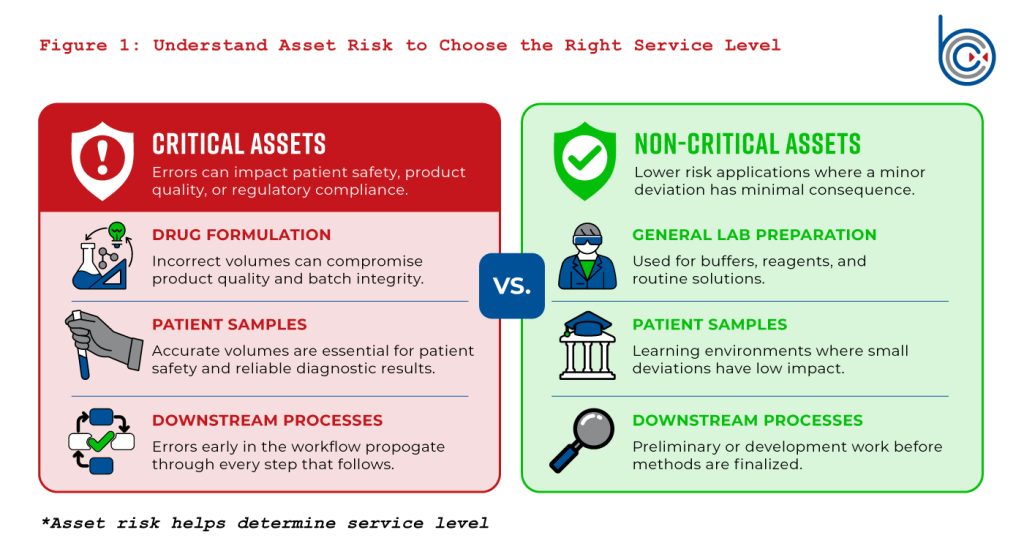
Not every pipette in a lab carries the same weight. Some pipettes feed directly into decisions and processes where an error would be costly, and others handle work where a small deviation would cause little harm. Understanding this difference is the first step in choosing the right level of calibration service, because the service level should match the risk the instrument carries. Paying for the highest level of service on a low-risk pipette wastes money, and using a basic level of service on a high-risk pipette exposes the lab to consequences it cannot afford. Sorting your pipettes into critical and non-critical assets is how you make that decision with confidence.
A critical asset is a pipette where a wrong measurement carries serious consequences. Sometimes the consequence comes from what follows in the process. If the pipette sits early in a workflow and every downstream step depends on that volume being correct, an error propagates through everything that follows. Other times the consequence comes from the product itself. A pipette used to formulate a drug product, prepare a patient sample, or set a concentration in a regulated process can cause a product to be formulated incorrectly if it dispenses the wrong volume, and that can affect patient safety, batch quality, or the validity of a reported result. These instruments demand tighter accuracy, more complete documentation, and a calibration that will hold up under scrutiny.
A non-critical asset carries less risk in its measurements. These pipettes handle work where a small error would not derail a process or compromise a product. A pipette used for general lab preparation, teaching, or early exploratory work still needs to function correctly, but the consequences of a minor deviation are low. For these instruments, a calibration that confirms the pipette works within its specification is often all that the work requires. The goal is not to treat every pipette the same. The goal is to match the level of service to the risk, so that critical assets get the rigor they need and non-critical assets get reliable service without unnecessary cost.
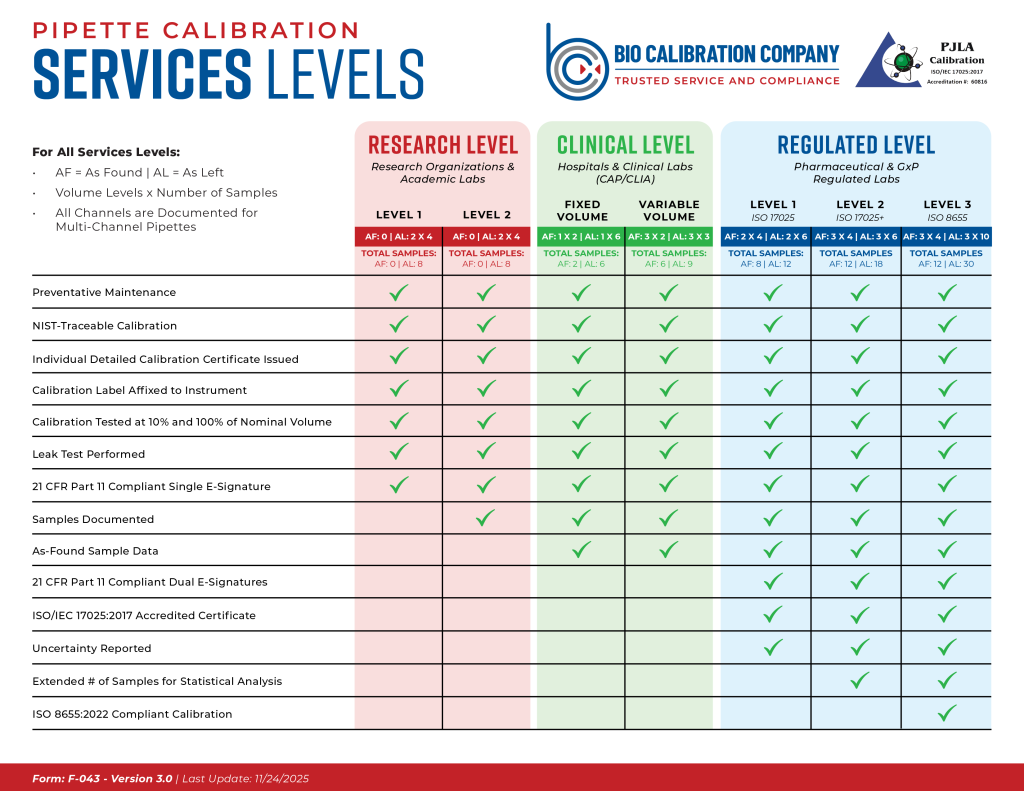
Once you have sorted your pipettes by risk, the next step is to match them to the right service level. Bio Calibration Company offers three pipette service levels, and each one serves a different type of laboratory and a different level of risk. The Research Level serves research laboratories, universities, and organizations that need basic calibration to ensure accurate instrument functionality, with less emphasis on reporting. The Clinical Level includes everything in the Research Level. It adds sample data documentation to the certificate of calibration and is built for hospitals, clinical laboratories, and labs following CAP guidelines. The Regulated Level includes everything in the Research and Clinical Levels. It adds an ISO/IEC 17025:2017-accredited certificate of calibration; it is the premier option for pharmaceutical and GxP-regulated organizations that require the highest level of instrument calibration. The sections that follow give a use case for each level.
Consider a university research laboratory running early-stage exploratory experiments. The team uses a set of single-channel pipettes for general sample preparation, buffer mixing, and preliminary assays. The work is not yet standardized; it is not submitted to a regulator, and a small volume deviation would not compromise a product or a patient. These are non-critical assets. What this lab needs is confidence that its pipettes function accurately and a calibration that keeps the instruments maintained, without the added reporting overhead that a regulated environment would require.
The Research Level fits this lab well. It provides basic calibration to confirm the pipettes are functioning accurately, along with maintenance that keeps the instruments in good working order, and it puts less emphasis on reporting because the work does not demand it. The lab gets reliable, NIST-traceable service that keeps its pipettes performing, and it does not pay for documentation it will never use. For a university or research setting with many low-risk instruments, this is the practical and cost-effective choice. It also standardizes service across the campus, which simplifies scheduling and keeps every instrument on a known maintenance cycle.
Learn more about our Research Level pipette service.
Consider a hospital clinical laboratory that runs diagnostic testing and operates under CAP guidelines. The pipettes here prepare patient samples and reagents that feed directly into diagnostic results, so an error carries real consequences for a patient and for the lab’s compliance standing. These pipettes lean toward the critical side, and just as important, this lab has to show its work. CAP-accredited laboratories need documented, traceable evidence that their volumetric equipment performs correctly, which means a certificate that carries actual measurement data, not just a statement that the pipette passed.
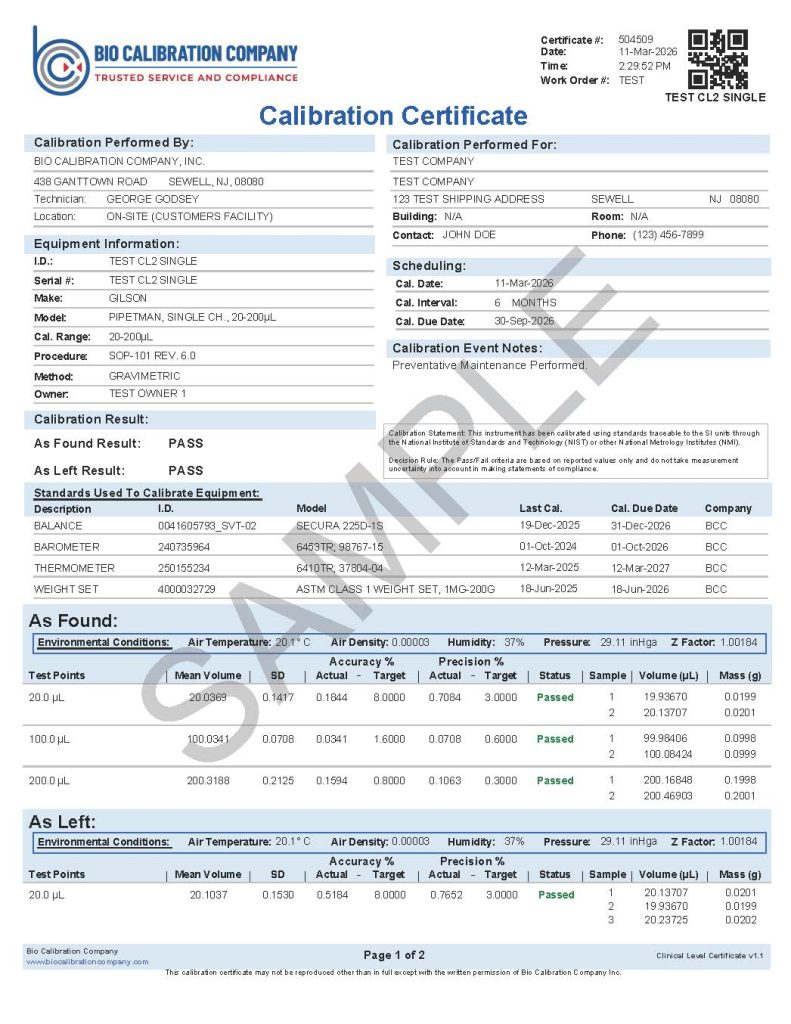
The Clinical Level fits this situation exactly. It includes everything in the Research Level and adds sample data documentation to the calibration certificate, giving the lab the measurement evidence it needs to satisfy CAP guidelines and demonstrate performance during an inspection. Bio Calibration Company can tailor the service to the number of samples, the volume levels, and the specific fields the lab needs on its certificate or label. For a clinical or hospital laboratory, this level delivers both the maintenance that keeps pipettes accurate and the documentation that keeps the lab compliant and audit-ready.
See how our Clinical Level service supports CAP-guided labs.
Consider a pharmaceutical company formulating a drug product under GxP requirements. The pipettes used to set concentrations and formulate the product are critical assets in the fullest sense. If one dispenses the wrong volume, the product can be formulated incorrectly, with consequences for patient safety, batch release, and regulatory standing. This company is highly concerned with accuracy, and it answers to regulators who expect certificates that carry all required information and that come from an accredited source. The Regulated Level answers exactly this situation.
The Regulated Level includes everything in the Research and Clinical Levels and adds an ISO/IEC 17025:2017-accredited calibration certificate. It meets the standards these labs live under, including ISO/IEC 17025:2017, ISO 8655, 21 CFR Part 11 for electronic records and signatures, and GxP practices such as GMP, GLP, GDP, and GCP. As the highest-level offering, it can be customized with sample data, uncertainty reporting, custom test points, custom certificates and labeling, and integration with the lab’s systems. For a pharmaceutical or GxP-regulated organization, this level provides the accuracy the process demands and the documentation the regulators require.
What an ISO/IEC 17025 Accredited Certificate Gives You
The accredited certificate is the heart of the Regulated Level, and it is worth understanding what accreditation actually provides. An ISO/IEC 17025 accredited certificate is more than a statement that a calibration happened. Accreditation means an independent accreditation body has assessed the calibration provider and confirmed its technical competence, impartiality, and consistent operation. When a certificate carries the accreditation mark, it tells a regulator or an auditor that a lab performed the calibration whose methods, equipment, and measurement uncertainty an accreditation body has independently verified. This carries weight during an FDA audit that a non-accredited certificate does not have. It provides defensible, traceable evidence that the measurement can be trusted, which is exactly what a critical asset in a regulated process requires.
Why the Regulated Level and ISO 8655 Go Further Than a Standard Calibration
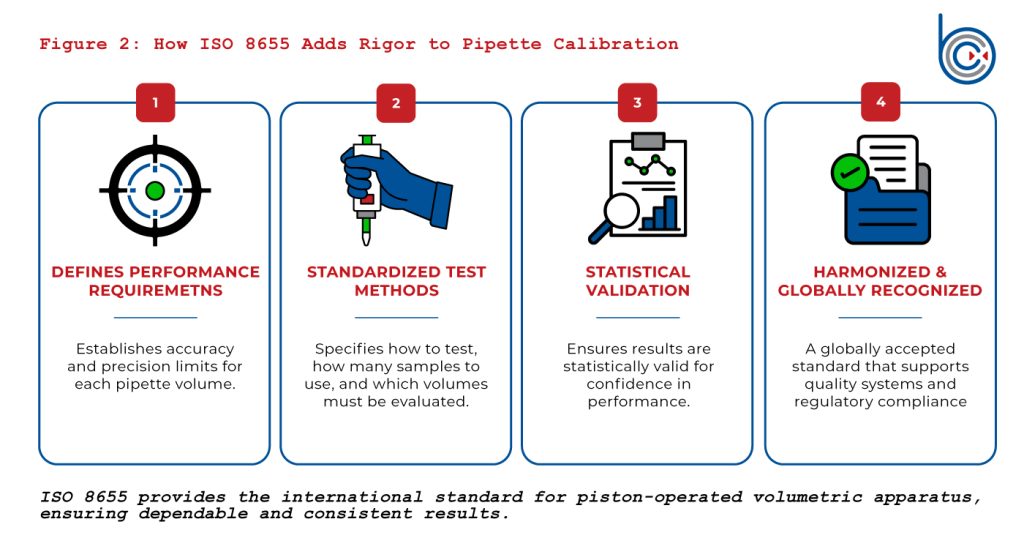
The Regulated Level draws on ISO 8655, and this standard is different from most calibrations in ways that matter for critical assets. A typical calibration confirms that an instrument reads within a tolerance. ISO 8655 goes further, because it defines a complete framework for how a pipette must be evaluated and what it must achieve to pass. This standard is stricter than a standard calibration for several reasons, and each adds a layer of rigor.
Good use cases for the Regulated Level with ISO 8655 are those where accuracy is not negotiable and the result must stand up to a regulator. Formulating drug products, releasing batches, validating a process, and any critical asset whose measurement feeds a regulated decision all belong here. When the consequence of a wrong volume is high, and the certificate has to satisfy an auditor, the Regulated Level with its accredited certificate and ISO 8655 method is the right choice.
Request a quote for our ISO/IEC 17025 accredited Regulated Level service.